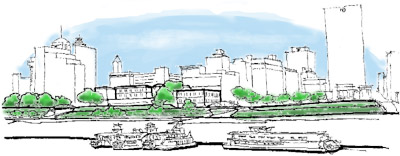
Beale Street Landing Underway

by Lynda Ireland

Over 200 Memphians gathered at the river under two large shade trees at the groundbreaking ceremony, highlighted by Reverend Benjamin Hooks’ blessing and Middle Baptist Church gospel choir’s lively rendition of “O Happy Day.” Mayor Willie W. Herenton mentioned a visit years ago by Atlanta Mayor Maynard Jackson who pointed out that Memphis has something Atlanta is missing: the Memphis riverfront.

Other speakers included RDC chairman Greg Duckett, City Councilor Barbara Ware whose 7th district includes the riverfront, and Captain William Lozier of Memphis Riverboats whose brief remarks concluded with a friendly horn blast from the Memphis Queen out in the channel. Speakers recognized Pat Kerr Tigrett as a pioneer in riverfront enhancement with the lighting of our Hernando DeSoto Bridge. A diverse audience was very enthusiastic, so perhaps other riverfront projects in which FfOR has strong interest, such as the Historic Cobblestone Landing, the Public Promenade, extending the Bluffwalk, and Mud Island River Park, may benefit from a groundswell of public awareness.

[Click here to read more...]

Maurice Cox at Center City Commission

As Maurice Cox, NEA Director of Design, told the audience at yesterday's Center City Commission luncheon, "the goal is beautiful, livable, and integrated cities." The National Endowment for the Arts (NEA) stands for excellence in art, one of which is urban design, and supports the growth and availability of art to all Americans. Here are some highlights from his talk and suggestions for Memphis along with audio recordings.

Mr. Cox stressed that there is often a gap between people's values and the reality of how we are living that requires critical thinking and new learning. He gave examples from the Mayor's Institute program and from his own city, Charlottesville, VA. Faced with outward migration and strangulation by its growing suburbs, the community came together to define their values, refocused on creating an urban pedestrian downtown, and has today become one of the best places to live in America.
( Entire talk 36 mins, 6.3 MB )

Toward the end of his talk he gave some specific examples and ideas for Memphis. Three short clips for your consideration:

Louisville waterfront (2.5 mins, 425 KB)
He used Louisville as a success story. There, the Mayor held the line on development and turned the brownfield along the river into 100 green acres of public park.

Lessons for Memphis (2.5 mins. 442 KB)
Specific suggestions for Memphis.

Memphis Riverfront (1 min. 155 KB)
He closed with these words...
And then, lastly, the most memorable moment for me, visiting Memphis, was looking out at your extraordinary natural resource, and that's the river. And I would encourage you to preserve your riverfront as a public living room of Memphis - at all costs. [Applause] Because the collective dignity of Memphis begins at the river, and you should give it back to the public to whom it rightfully belongs. And with that I say to Memphis, thank you, and go out and please shape your world. Thank you.

BIO:
Maurice Cox
Director of Design, National Endowment for the Arts

In addition to his role as NEA's Director of Design, Maurice Cox is an Associate Professor of Architecture at the University of Virginia School of Architecture and is a 2004-05 recipient of the Loeb Fellowship at Harvard University's Graduate School of Design.

He recently completed eight years on the Charlottesville (VA) City Council with the last two years as the City's mayor. As mayor, professor, and urbanist he was widely recognized as the principal urban designer of his City.

His reputation as a design leader and innovator led to his being featured in Fast Company, as one of America's "20 Masters of Design;" on CBS news magazine "60 Minutes;" in the documentary film This Black Soil; and in the New York Times, Washington Post, and Architecture Magazine -- all for his groundbreaking use of design as a catalyst for social change.

[Click here to read more...]

Fireworks on the 4th in Tom Lee Park


The Red White and Blues Star Spangled Celebration, sponsored by FM 100 and the Beale Street Merchants Association, will bring fireworks, music, and family activities to Tom Lee Park on the 4th of July. Click here to learn more.

[Click here to read more...]

2 events, 2 great speakers - July 8 & 10


Sustainable Shelby -- On July 8, at 2:30 pm, at the Botanic Garden, Mayor Wharton will role out the top ten sustainable goals for Shelby County – it’s the culmination of months of work by County staff and citizens to set priorities and map out a plan for future smart growth. Doug Farr, author of Sustainable Urbanism, the guidebook for this process, will be the guest speaker. Free.


Center City Commission Annual Luncheon -- On July 10 at 11:30 am in The Peabody Hotel's Grand Ballroom, the Center City Commission will host its Annual Luncheon. Keynote speaker, Maurice Cox, Director of Design with the National Endowment for the Arts, will share his experiences and take a look at trends in Memphis and downtowns across the nation. $55. To register online, click here.

Here’s some additional information about these two outstanding speakers.


Doug Farr, an architect and urban designer, is the founding principal and president of Farr Associates, which focuses on form-based codes, transportation corridors, neighborhoods, historic preservation and adaptive reuse. Mr. Farr has served as cochair of the Environmental Task Force of the Congress for the New Urbanism, chair of the AIA Chicago Committee on the Environment, and chair of the U.S. Green Building Council’s LEED for Neighborhood Development (LEED-ND) Core Committee.

Unlike the original LEED program, which rates only single buildings and for which site selection is an afterthought, LEED-ND "will place the emphasis on the elements that bring the buildings together into a neighborhood, and relate the neighborhood to its larger region and landscape," says the council.

A founding principal and president of Farr Associates in Chicago, Mr. Farr’s book, Sustainable Urbanism, has served as the text book for Mayor Wharton’s Sustainable Shelby and presents ideas on how to integrate architecture, city planning, and nature for a better way of life.
For more information on Doug Farr, click here and here.


For Memphians this will be a second chance to hear Maurice Cox’s incisive and creative comments on how to equate design with quality of life issues and ways to democratize design. In addition to his role as NEA’s Dir. of Design, Cox is an Asso. Professor of Architecture at the Univ. of VA and is a 2004-5 recipient of the Loeb Fellowship at Harvard Univ.’s Grad. School of Design. Mr. Cox has recently served 8 years on the Charlottesville, VA City Council with the last 2 years as the city’s mayor.
For more information on Mr. Cox, click here and here.

To read Jeff Speck’s interview with Maurice Cox, click here

[Click here to read more...]

Want to know more about the historic Cobblestone Landing and Wetlands at the foot of Beale?

Click here and here to access information about the historic Cobblestone Landing.
Click here and here to access information about the wetland buffer at the foot of Beale Street.

[Click here to read more...]

Mayor Riley - attention to detail and a listening ear


Recognized as one of the most visionary and effective leaders in America, Charleston, S.C. Mayor Joe Riley spoke in Memphis in Sept. of 2005 at a program sponsored by Friends for Our Riverfront, Memphis Heritage, and the American Institute of Architects.

We've continued to follow Mayor Riley's successes. Here's an article that appeared on the Project for Public Spaces website about the role of Mayors today and how Riley's attention to detail and listening ear have made a tremendous difference in Charleston.

Joe Riley helped revive Charleston, South Carolina, by listening to people and paying attention to details
By Jay Walljasper

Bill Clinton, a man whose self-deprecating charm has carried him far in life, loves to tell a story about his appearance on a Shanghai radio show. It was a historic event: The president of the United States would field questions from everyday citizens in a nation notorious for its tight lock on information. But to Clinton’s surprise, two-thirds of the calls coming into the station were not directed at him, but to his host, the mayor of Shanghai. “People were more interested in talking to the mayor about potholes and traffic jams,” Clinton laughs.

Actually, when you reflect a moment, this shouldn’t be such a surprise. Mayors, who are representatives of the government closest to people, stand in a better position to actually get things done than the most powerful man on Earth. Mayors operate on the front lines of democracy, and when they do their jobs right with a keen understanding of the importance of place in their community, they can play a huge role in making their cities great.

Here's how Joseph Riley Jr.—who has been at the helm in Charleston, South Carolina, for 30 years, making him one of America’s longest-serving mayors—describes the job: “You have a personal relationship with people. You pick up their garbage. You make them feel safe. You try to help them when they are in trouble. It’s a chance to do things directly for people—for the poorest person in town as well as the rich.”

No one would cast Riley, a small, dignified man who speaks with a soft voice, in the role of a political powerbroker. Yet he has reshaped this city of 105,000 to such an extent that few who knew it in the 1970s— as a poor, racially torn backwater that had lost hope in the future—would recognize it today.

Riley vigorously led Charleston’s turnaround by paying careful attention to the strong sense of place that characterizes this city. He has preserved the city’s historic qualities, and even improved upon things with charming new parks, developments and attractions that blend in with the classic 18th- and 19th-century architecture everyone loves. Charleston is also known around the world for its springtime Spoleto arts festival, which Riley brought to town in partnership with the famous Italian composer and impresario Gian Carlo Menotti.

For most Charlestonians, however, these accomplishments pale in comparison to Riley’s leadership during the devastating Hurricane Hugo of 1989. After ordering an all-out evacuation, Riley and city staff helped people flee to safety and stayed behind to protect the city. Almost as soon as the winds died, he launched a full-force program to make Charleston “more beautiful and vital than ever.” The triumph of Riley’s rebuilding efforts can be seen in the delighted smiles of tourists who come from all over the U.S. to wander the city’s streets and in the envious looks of other mayors who come to learn Charleston’s secret at the Mayors’ Institute on City Design, which Riley founded in 1986.

The secret is simple: Riley’s careful attention to the details shows what distinguishes a great city from a merely okay one.

I begin to understand the magic of Riley’s leadership as we walk out of city hall, where he has patiently but stiffly answered my questions from behind his desk, and head out onto the bustling avenue outside. He seems suddenly charged with electricity. My long legs struggle to keep up with his short ones as he bounds down the street, calling hello to nearly everyone we pass—black and white, young and old, rich and poor. He’s a leader who listens to people, and welcomes their ideas about how to improve things around town.

We turn up an alley and sneak through someone’s backyard gate so I can see what Riley considers one of the finest flower gardens in town. At one point, he almost knocks me over in his excitement to point out a construction worker eating lunch on a park bench—the man is using a nearby ledge for a footrest, just the way Riley planned it. Hurrying over to investigate a couple of police cars he sees stopped behind a house, he seems visibly relieved to find that the problem is just a malfunctioning burglar alarm. He thanks each of the officers by name and we continue our stroll.

“See that building there,” he says, stopping abruptly in front of the Old Exchange Building, a historic site once visited by George Washington and now operated by the state of South Carolina. “One day I was walking past, just like we are now, and I saw the stucco was discolored, so I called up the state authorities right away to tell them about it. They seemed surprised that I noticed, but I told them, ‘that’s my job.’”

Joe Riley is one of a new breed of mayors around the world who see their jobs as nothing less than helping deliver security, opportunity and happiness to residents of their cities. Indeed, we may now be entering a new age in history when mayors play a leading role on the world’s political stage.

Mayors like Ken Livingstone of London (who defied all conventional wisdom by imposing a hefty toll on cars entering central London), Richard M. Daley of Chicago (who turned a gritty town into a top contender for title of world’s greenest city) and Bertrand Delanoë of Paris (who hopes to top Livingstone in his ambitious efforts to reclaim Paris from traffic) are already more influential and well-known internationally than many prime ministers and presidents. Indeed, Myung-bak Lee, former Mayor of Seoul, who made the city into a symbol of livability by replacing an elevated highway with a riverfront park that winds four miles through the city centre, was recently elected president of South Korea.

But even more influential may be former Bogotá mayor Enrique Penalosa, who built many new schools, libraries, parks, the world’s longest pedestrian street, 300 kilometers of bike paths, a greenway winding through the city, and a 21st-century Bus Rapid Transit system while in office. He once considered running for Colombia’s presidency, but now spends his time persuading municipal officials in Mexico City, Cape Town, Beijing, Delhi, Jakarta, Dar-es-Salaam and many other cities around the world to think differently about what’s needed to make their cities great.

This article appeared on the Project for Public Spaces website. For additional interesting articles about successful cities and public spaces, click here.

Mayor Riley, co-founder of the Mayor's Institute on City Design, has received the Presidential Award for Design Excellence for public housing, the Urban Land Institute J. C. Nichols Prize for Visionaries in Urban Development, and the American Architectural Foundation Keystone Award for exemplary leadership in using architecture to transform a community.

Click here for a synopsis of Mayor’s Riley’s presentation in Memphis.

[Click here to read more...]

The Cossitt - "Investing in a Sustainable Future"

"To be recognized globally as the city of choice in which to live, learn, work, and recreate" is stated as our City Vision on the cover of this year's CIP Overview booklet. It says we are "Investing in a Sustainable Future." So how does closing our libraries fit with this vision?

For years our branch libraries have been neglected, and none more so than the Cossitt, but closing the libraries to save $2M does not make Memphis a more vibrant city or a better place to live, learn, or work.

Before we close a library, its replacement should be planned and budgeted. Closing the historic downtown Cossitt will only leave us with another empty public building on the riverfront and a segment of Memphians without access to books and computers. There should be a public process to consider improvements and restoration of the Cossitt's historic addition, its use as a library or alternate public use, and, if it is to be closed, an alternate site plan for a downtown library.

Click here to read Otis Sanford's persuasive editorial on why we should save the Cossitt.
Click here to get a copy of Project for Public Spaces report. Their suggestions for ways to improve the Cossitt are on page 19.

[Click here to read more...]